User security

What is user security?

User security is the practice of protecting an organization's users, their digital identities, and their access to applications, data, networks, and systems from threats such as phishing, credential theft, unauthorized access, and account compromise. A user security program brings together identity verification, access control, behavior monitoring, security awareness training, and incident response so that the right users reach the right resources and risky activity is detected quickly.

What is the importance of user security?

User security is the practice of protecting an organization's users, their digital identities, and their access to applications, data, networks, and systems from threats such as phishing, credential theft, unauthorized access, and account compromise. A user security program brings together identity verification, access control, behavior monitoring, security awareness training, and incident response so that the right users reach the right resources and risky activity is detected quickly.

A user security program typically covers five core components:

Identity verification: Confirms that a user is who they claim to be, using methods such as multi-factor authentication (MFA), two-factor authentication (2FA), and passwordless authentication. Access control: Determines what verified users can do, using identity and access management (IAM), least-privilege rules, and role-based access. Behavior monitoring: Detects activity that may indicate a compromised account, using authentication logs, login anomaly alerts, and session analytics. Security awareness training: Helps users recognize and avoid phishing, social engineering, and other behavior-based threats. Incident response: Defines how teams react to user-related security events, including account suspension, session revocation, password reset, and access review.

For authoritative guidance, the National Institute of Standards and Technology (NIST) publishes SP 800-63 Digital Identity Guidelines for identity proofing, authentication, and federation, and the NIST Cybersecurity Framework 2.0 for managing cybersecurity risk across an organization. A strong user security program connects that guidance to the daily controls that protect users, including identity and access management, multi-factor authentication, single sign-on, and a written user authentication policy.

User security focuses on protecting users, their identities, and their access, while endpoint security focuses on protecting the devices used for access, such as laptops, smartphones, tablets, and servers. Together, they support a layered approach to security, where every access request is verified before trust is granted.
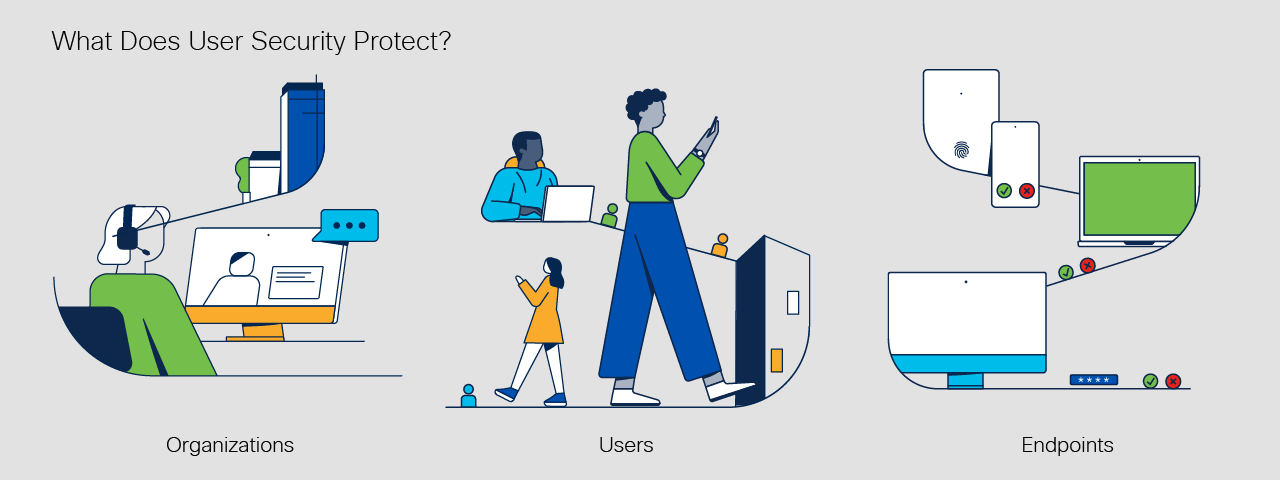
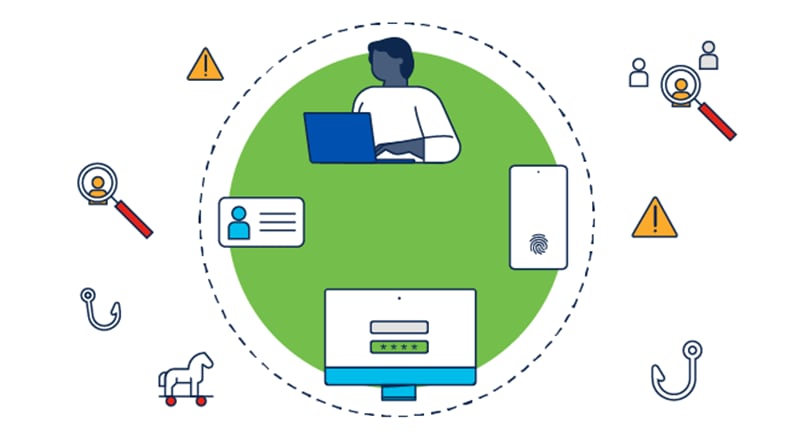
Illustration of how a user’s data and applications are securely protected from phishing, viruses, and other cyberattacks

Core components of a user security program

ComponentFunctionTypical capabilities
Identity verificationConfirms users before access is granted.MFA, 2FA, passwordless authentication, account recovery
Access controlHelps ensure users have the appropriate level of access to applications and data.

IAM, least privilege, role-based access, policy enforcement

Behavior monitoringIdentifies activity that may indicate unauthorized access or account compromise.Authentication logs, login alerts, activity monitoring
TrainingHelps users recognize and avoid risky behaviors and social engineering.

Phishing awareness, secure password habits, reporting guidance

Incident responseHelps security teams respond to user-related events.Account suspension, session revocation, password reset, access review

User security solutions

Free trial

Cisco Secure Endpoint 30-day trial

Stay ahead of the next threat with simplified, automated endpoint management.

Demo

Explore Secure Endpoint demos

Learn how you can protect your organization from breaches and advanced threats with the Secure Endpoint live demo, as well as walk-through videos.

Video

Cisco Secure Endpoint overview

Cisco Secure Endpoint can help solve your operational challenges and improve your security.

What are examples of user security?

Examples of user security technology and measures include:

  • Strong passwords and MFA
  • Regular software updates and patches
  • Firewalls and anti-malware software
  • Secure browsing practices
  • Employee cybersecurity training
  • Access controls and user permissions
  • Incident response and monitoring systems

How do you provide security to users?

Organizations can provide user security by deploying a secure user authentication solution, endpoint threat protection, and secure internet connectivity. Training employees on end-user security awareness and cybersecurity hygiene also helps protect users, devices, and online activity.

Learn about trusted-access tools

What is end user security?

End-user security focuses on protecting and equipping users who use organizational devices, software, and data. To safeguard user and corporate data, security training and solutions are deployed. User security is a broader term that includes IT staff, network admins, and developers.

What is the role of end users in cybersecurity?

An end-user's role in cybersecurity is to practice healthy digital hygiene to help prevent cyberattacks by:

  • Using strong passwords and multi-factor authentication (MFA)
  • Avoiding suspicious emails and links
  • Keeping software up to date
  • Reporting security incidents
  • Adhering to corporate security policies

Watch video on best practices (11:02)

What is end-user security awareness?

End-user security awareness refers to educating users about online threats and providing them with the best practices to identify and avoid potential risk. By boosting user security awareness and implementing effective security hygiene, users can help lower the organizational risk of cyberattacks.

What are common types of user security?

Endpoint security

Endpoint security solutions protect individual devices, such as computers, smartphones, or tablets, from cybersecurity threats. These solutions defend against malware, unauthorized access, and data theft through threat hunting, incident management, and device visibility features.

Secure internet gateway (SIG)

A secure internet gateway (SIG) is a cloud-based security service that provides users with secure access to the internet. A SIG helps protect users from online threats by enforcing security policies, filtering out malicious content, and detecting and blocking malware in real time.

Identity and access management (IAM)

Identity and access management (IAM) is a security framework that enables organizations to control user access to applications and data. IAM solutions that use zero-trust principles support user security by allowing only authorized users access to sensitive information, applications, and systems.

Next-generation firewall (NGFW)

A next-generation firewall (NGFW) is a network security tool that combines traditional firewall capabilities with advanced features like intrusion prevention, threat intelligence, and application control. An NGFW protects users by identifying and blocking malicious traffic, preventing unauthorized access, and providing granular control over network traffic. 

Cloud data security

Cloud data security involves protecting data stored in cloud environments. It includes measures such as encryption, access controls, and monitoring to help ensure user and corporate data privacy, integrity, and availability. Leading cloud-security providers also offer security features and compliance certifications to help protect customer data

Multi-factor authentication (MFA)

Multi-factor authentication (MFA) enhances user security by requiring multiple forms of verification (such as passwords, biometrics, or tokens) to access an account or system. By adding an extra layer of authentication, MFA reduces the risk of unauthorized access—even if passwords are compromised..

Email Security

Email security solutions protect users from email-based cyberthreats like phishing attacks, spam, and malware. These solutions work by filtering email content, attachments, and URLs to identify and block malicious content. Features like encryption, data loss prevention, and advanced threat protection also work to safeguard sensitive user and corporate data.

Mobile Device Management (MDM)

A mobile device management (MDM) solution enables IT administrators to enforce security policies, configure device settings, and remotely monitor and secure devices. MDM solutions protect user security by helping to ensure that devices are compliant, implementing strong authentication, and enabling remote actions like locking or wiping devices in case of loss or theft.

Malware protection

Advanced malware protection (AMP) is a security software designed to prevent, detect, and remove malware and other threats, such as ransomware, worms, Trojans, and spyware. AMP software protects endpoint devices (like computers, smartphones, or tablets) through device visibility, threat hunting and intelligence, and incident management and response.

Frequently Asked Questions about User Security

User security is the practice of protecting an organization's users, their digital identities, and their access to applications, data, networks, and systems from digital threats and unauthorized access. It includes identity verification, access control, behavior monitoring, security awareness training, and incident response.

User security focuses on the user side of access: identities, authentication, access privileges, and security behavior. Endpoint security focuses on the device side: protecting laptops, smartphones, tablets, and servers from malware and other threats. The two work together because a verified user on a compromised device, or a trusted device used by an unauthorized person, both create risk that one control alone cannot address.

The five main components of a user security program are identity verification, access control, behavior monitoring, security awareness training, and incident response. Identity verification confirms who a user is, access control determines what they can do, behavior monitoring detects suspicious activity, training reduces user-driven risk, and incident response defines how the security team reacts when something goes wrong.

Multi-factor authentication (MFA) is one of the most important controls in a user security program because it requires more than a password to verify identity. Even if a password is stolen through phishing or a data breach, MFA prevents the attacker from gaining access without the additional factor, such as an approved device, a one-time code, or a biometric.

User security is a foundational input to Zero Trust because Zero Trust evaluates every access request based on identity, device posture, and context before granting access. User security provides the identity verification, access controls, and behavior signals that Zero Trust policies use to decide whether a request is trusted, requires step-up authentication, or should be denied.


Related cybersecurity topics

What is a user authentication policy?

A user authentication policy verifies a user's identity to secure service access.

What is identity and access management (IAM)?

IAM makes sure that people and entities with digital identities have the right access levels.

What is a data breach?

A data breach is a security violation that exposes sensitive data to an unauthorized party.

What is multi-factor authentication (MFA)?

MFA enables organizations to verify users' identity before they can gain entry to critical systems.

What is single sign-on?

Single sign-on (SSO) allows one login for multiple apps and websites.

What are password security and protection best practices?

Password security best practices create strong passwords to protect devices, files, and accounts.

Webinar

Secure Endpoint webinar

Our experts can help you get the most from your endpoint security. Register for any of our Cisco Secure Endpoint webinars.